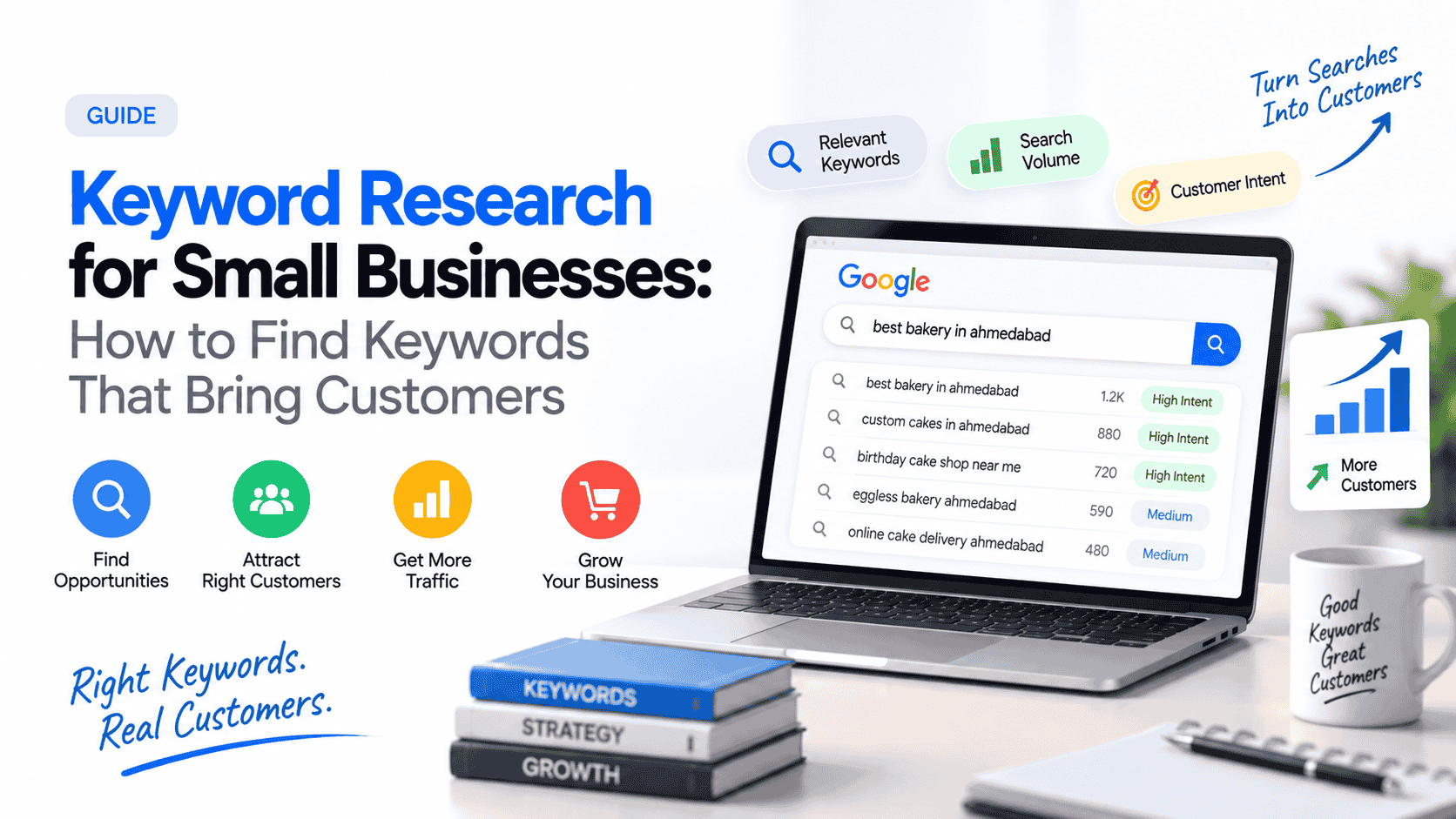
Keyword Research for Small Businesses: Find Keywords That Bring Customers
12 Sept 2026 9 min readSanket Jain
Learn practical keyword research for small businesses in India. Find high-intent, local and commercial keywords that actually bring customers and leads.
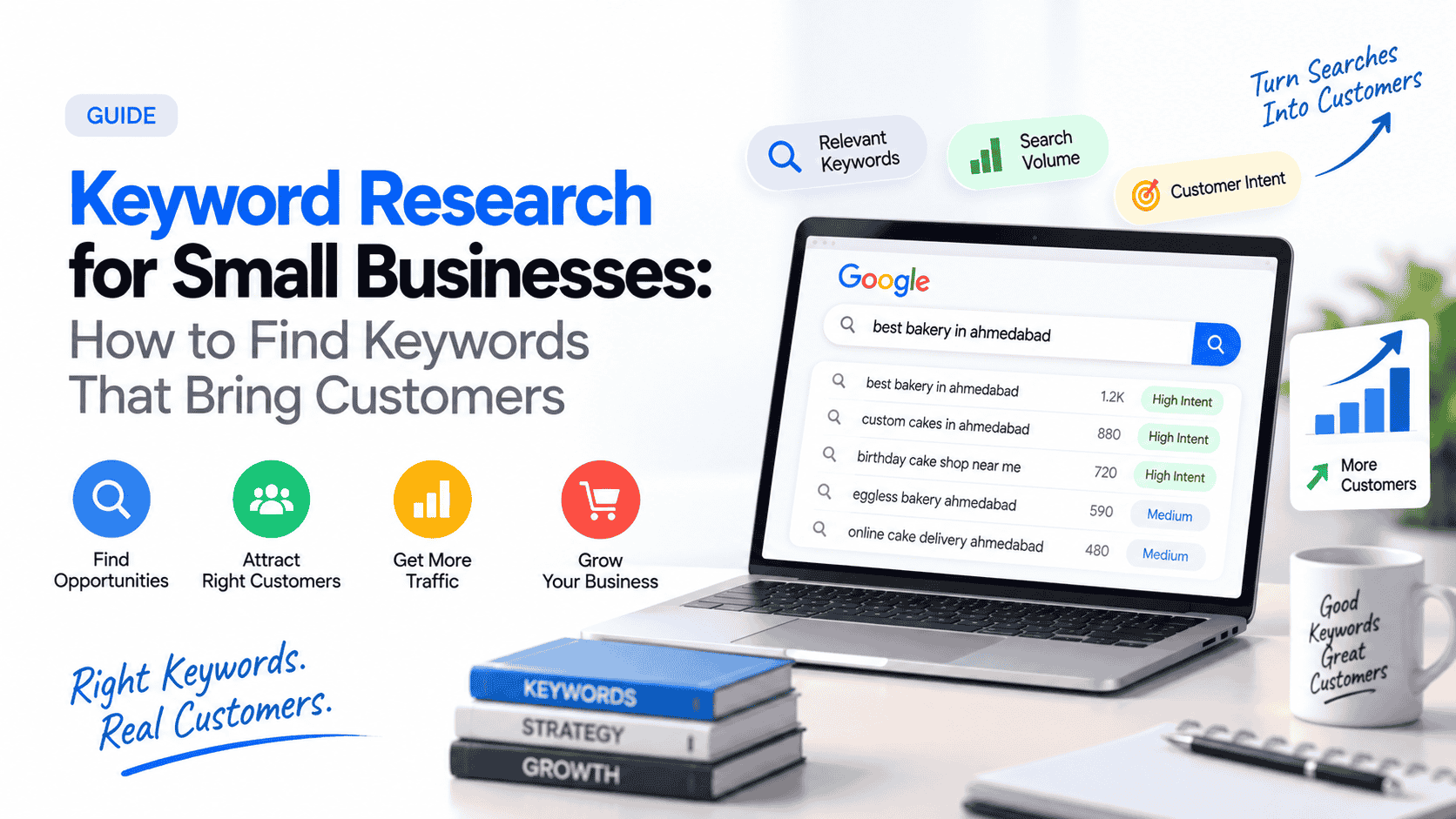
Keyword Research for Small Businesses: How to Find Keywords That Bring Customers
Most small businesses in India either skip keyword research or chase the wrong keywords. They target broad terms with high search volume that never convert, or they optimise pages for phrases no real customer ever types.
Keyword research for small businesses is the process of discovering the exact words and phrases your potential customers use when they are looking for your products or services on Google. Done correctly, it tells you what pages to create, what language to use, and which opportunities are realistic for a small business to rank for.
This guide shows you how to do keyword research for a small business step by step. It focuses on finding keywords that bring customers — not just traffic. You will learn how to identify commercial and local keywords, evaluate search intent, use free tools, and map keywords to the right pages on your website.
If you are building a broader SEO foundation, start with our complete SEO guide for small businesses. For local visibility, see the local SEO guide and the Google Business Profile SEO guide.
Why Keyword Research Matters for Small Businesses
Without keyword research, you are guessing what customers search for. Guessing leads to:
Pages that attract the wrong visitors
Blog posts that get traffic but no enquiries
Service pages that never rank
Wasted time and money on content that does not convert
Good keyword research helps you:
Understand real customer language and problems
Prioritise pages that can generate leads and sales
Compete effectively against larger websites by targeting realistic opportunities
Align your website content with actual search intent
For small businesses, the goal is not the highest search volume. The goal is keywords that attract people ready to buy, book, or enquire.
High Traffic vs High-Value Keywords
This distinction is critical.
KeywordIntentCompetitionBusiness Valuewhat is SEOInformationalHighLowSEO tips for small businessesInformational / ResearchMediumMediumsmall business SEO servicesCommercialMediumHighSEO company in DelhiTransactional / CommercialHighVery Highaffordable SEO services for small businessesCommercialMediumHighSEO services near meTransactional / LocalMediumVery High
A keyword with 10,000 monthly searches that brings zero customers is less valuable than a keyword with 200 monthly searches that regularly produces enquiries.
Always evaluate keywords on business relevance and conversion potential first, then look at volume and competition.
=>>>> For SEO related enquiry contact <<<<=
How to Do Keyword Research for a Small Business (Step-by-Step)
Step 1 — Understand the Business
Before opening any tool, clarify:
What products or services do you sell?
Who is the ideal customer?
Which locations do you serve?
What problems do customers want to solve?
What triggers a buying decision?
Example for a travel agency in Ahmedabad:
Services → tour packages, ticket booking, custom itineraries
Customers → families, corporate clients, pilgrims
Locations → Ahmedabad, Gujarat, nearby cities
Problems → planning stress, reliable operators, transparent pricing
This clarity prevents you from chasing irrelevant keywords later.
Step 2 — Create Seed Keywords
Seed keywords are the basic starting terms related to your business.
Examples:
Travel agency → “travel agency”, “tour packages”, “holiday packages”
Dental clinic → “dentist”, “dental clinic”, “teeth cleaning”
Salon → “salon”, “haircut”, “bridal makeup”
CA firm → “CA firm”, “GST filing”, “income tax return”
Web development → “web development”, “website design”, “ecommerce website”
Write 10–20 seed keywords based on your services and the language customers actually use.
Step 3 — Expand Keyword Ideas
Use free methods first:
Google Autocomplete — Start typing your seed keyword and note the suggestions.
People Also Ask — Expand the questions that appear.
Related Searches — Scroll to the bottom of the Google results page.
Google Keyword Planner — Requires a Google Ads account (free to use for research).
Google Trends — Check interest over time and regional differences.
Google Search Console — Once you have some data, see what queries already bring impressions.
Competitor websites — Look at the titles, headings and service pages of similar businesses that rank.
AI tools — Useful for generating variations and questions (validate later with real data).
For local businesses, always combine service + location:
“travel agency Ahmedabad”, “dentist in Satellite”, “salon near Bandra”, “CA firm in Pune”.
Step 4 — Analyse Search Intent
Google ranks pages based on what the searcher wants. There are four main types of search intent:
Informational — Learning (“what is GST”, “how to choose a travel package”)
Navigational — Looking for a specific brand or site
Commercial investigation — Comparing options (“best SEO company for small businesses”, “top dentists in Ahmedabad”)
Transactional — Ready to act (“SEO services near me”, “book dentist appointment Ahmedabad”)
Small businesses should prioritise commercial and transactional keywords for service and product pages. Use informational keywords for blog content that builds trust and supports the main pages.
Step 5 — Evaluate Keyword Opportunities
For each potential keyword, assess:
Search volume — Approximate monthly searches (directionally useful, not exact)
Competition / keyword difficulty — How hard it is to rank
Business relevance — Does this keyword match what you actually offer?
Conversion potential — How likely is the searcher to become a customer?
CPC (optional) — Higher CPC often indicates commercial value
A low-volume keyword that closely matches your service and location is often more valuable than a high-volume generic term.
Step 6 — Find Low-Competition Opportunities
Large national sites dominate broad keywords. Small businesses win by targeting:
Long-tail keywords (“affordable bridal makeup artist in Jaipur”)
Location-specific terms (“web development company in Ahmedabad”)
Niche services (“GST filing for freelancers in Pune”)
Specific customer problems (“best travel agency for family packages Ahmedabad”)
These keywords usually have clearer intent and lower competition.
Step 7 — Map Keywords to Pages
Assign primary keywords to specific pages:
Homepage — Brand + main service + primary location (if local)
Service pages — Main commercial keywords for each service
Location pages — Only if you genuinely serve that area and can create unique content
Product pages — Product-specific commercial terms
Blog posts — Informational and long-tail questions
FAQ sections — Common question keywords
One primary keyword (or tight cluster) per page is cleaner than stuffing multiple unrelated terms onto the same page.
Practical Keyword Examples for Indian Small Businesses
Travel Agency (Ahmedabad)
travel agency Ahmedabad (Commercial / Local)
best tour packages from Ahmedabad (Commercial)
family holiday packages Gujarat (Commercial)
how to choose a travel agency (Informational)
Dental Clinic
dentist near me (Transactional / Local)
best dentist in [area] (Commercial / Local)
teeth cleaning cost (Commercial investigation)
how often should I visit the dentist (Informational)
Salon
bridal makeup artist [city] (Transactional / Local)
best salon for hair spa near me (Commercial / Local)
haircut prices for women (Commercial investigation)
CA Firm
CA firm for GST filing [city] (Transactional / Local)
income tax return filing services (Commercial)
how to file ITR for freelancers (Informational)
Web Development / SEO Agency
web development company in Delhi (Transactional / Local)
SEO services for small businesses (Commercial)
affordable SEO company India (Commercial)
how to do SEO for a small business (Informational)
Notice how adding location and intent modifiers dramatically increases business value.
Keyword Research Tools: What to Use and When
Free / Low-Cost Options
Google Search (Autocomplete, People Also Ask, Related Searches) — Best starting point for real user language.
Google Keyword Planner — Free with a Google Ads account. Good for volume estimates and keyword ideas.
Google Trends — Useful for seasonality and regional interest.
Google Search Console — Shows what you already rank for and where you have potential.
Google Business Profile insights — Reveals local search terms that trigger your profile.
Paid Tools
Ahrefs / Semrush — Strong for competitor analysis, keyword difficulty, and content gap insights. Useful once you are more advanced.
Ubersuggest — More affordable option for basic volume and idea generation.
AI Tools (ChatGPT and similar)
Helpful for brainstorming seed keywords, generating long-tail variations, classifying intent, and creating content clusters. Always validate AI suggestions with actual search data. AI cannot reliably tell you exact search volume or true keyword difficulty.
Can I do keyword research for free?
Yes. Google Search features + Keyword Planner + Search Console + Trends cover most of what a small business needs in the beginning.
How to Use AI for Keyword Research
AI can speed up several parts of the process:
Generating seed keyword lists from a business description
Creating long-tail and question variations
Suggesting search intent for a list of keywords
Building topic clusters and FAQ ideas
Analysing competitor page structures
Example prompt approach:
“Act as an SEO specialist. Generate local and commercial keyword ideas for a travel agency in Ahmedabad that offers family and corporate tour packages. Focus on terms that show buying intent.”
After generating ideas, check them in Google Keyword Planner or by searching Google to confirm real demand and intent.
AI is a research assistant, not a replacement for validation.
Keyword Research Checklist for Small Businesses
Clear understanding of services, customers and locations
Seed keyword list created
Expanded ideas from Google Autocomplete, People Also Ask and related searches
Search intent classified for priority keywords
Business relevance and conversion potential evaluated
Low-competition and long-tail opportunities identified
Keywords mapped to specific pages
Primary keywords assigned without cannibalisation
Ongoing tracking set up in Google Search Console
How Many Keywords Should a Small Business Target?
Focus on quality over quantity. Most small businesses do well by prioritising:
5–15 high-value commercial and local keywords for core service pages
Supporting long-tail and informational keywords for content
It is better to rank well for 10 relevant keywords that bring enquiries than to rank poorly for 100 broad terms.
Turning Keyword Research into Customers
Keyword research is only valuable when it guides real action: creating or improving the right pages, writing content that matches intent, and measuring results in Google Search Console and your enquiry forms.
If you already have a website but are not getting consistent Google traffic or leads, the problem is often not the design alone. Keyword targeting, search intent alignment, content structure and technical SEO usually need attention.
SanketBuilds helps small businesses in India with practical SEO, local SEO, Google Business Profile optimisation and website development. We focus on keywords and pages that are designed to attract customers, not just traffic.
If you want help identifying the right keywords for your business or turning that research into pages that generate enquiries, get in touch for a conversation about what would make the most sense for your situation.
FAQs
How can I find keywords for my small business?
Start with your services and locations, expand using Google Autocomplete and People Also Ask, then evaluate intent and business value.
How do I do keyword research for a small business?
Follow the seven steps above: understand the business, create seeds, expand ideas, analyse intent, evaluate opportunities, find low-competition terms, and map keywords to pages.
What are the best keywords for small businesses?
Commercial and transactional keywords that include your service and location, plus long-tail phrases that match specific customer needs.
How can I find keywords that bring customers?
Prioritise buyer-intent and local keywords over pure search volume. Look for terms that indicate the searcher is ready to compare, contact or buy.
Can I do keyword research for free?
Yes. Google’s own tools and search features are sufficient for most small businesses starting out.
Is Google Keyword Planner free?
Yes, you can use it for keyword research with a Google Ads account even if you do not run ads.
How do I find low competition keywords?
Target long-tail phrases, specific services, and location-based terms instead of broad national keywords.
How do I find local keywords?
Combine your main service with city, neighbourhood or “near me” style language, then validate with Google Autocomplete and local search results.
What is more important: search volume or keyword intent?
Intent and business relevance are more important. High volume with wrong intent rarely produces customers.
Should small businesses target high-volume keywords?
Only if the intent matches and you have a realistic chance of ranking. Most small businesses get better results from focused, lower-volume commercial and local terms.