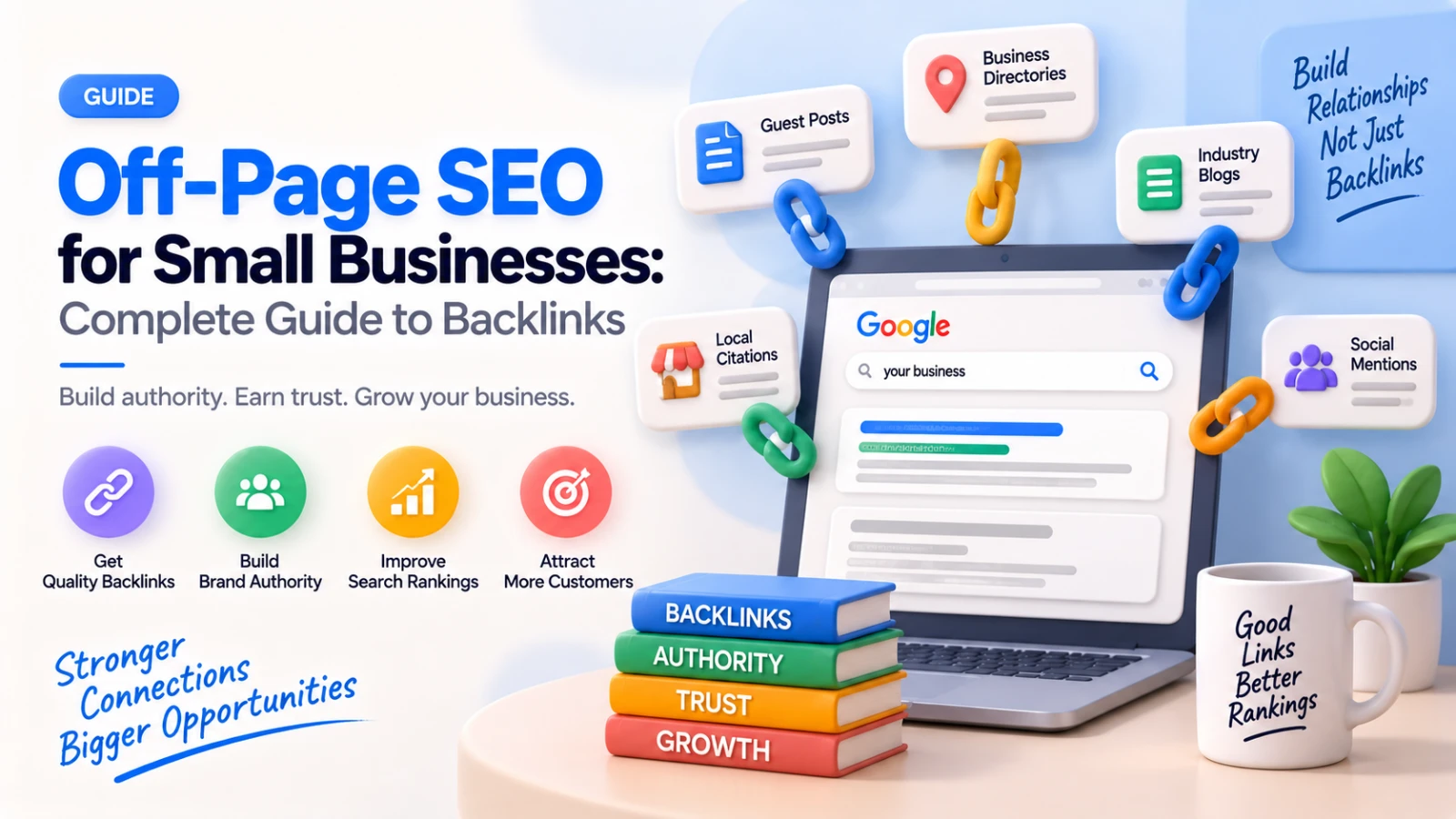
Off-Page SEO for Small Businesses: Complete Guide to Backlinks
14 Sept 2026 10 min readSanket Jain
Learn off-page SEO for small businesses, including backlinks, link building, local citations, digital PR and proven strategies to improve Google rankings.
Off-Page SEO for Small Businesses: Complete Guide to Backlinks, Authority & Rankings
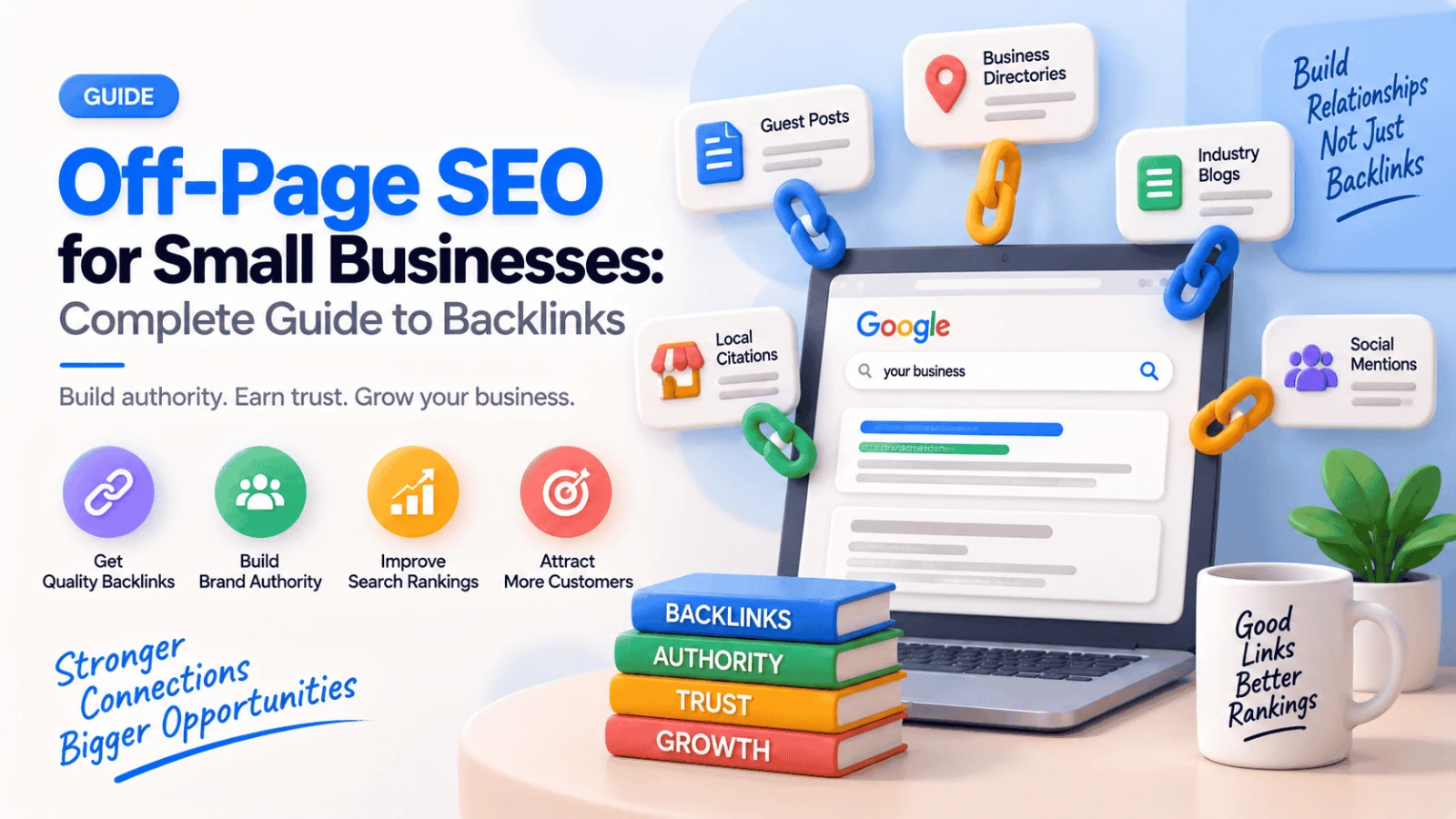
Off-page SEO is everything you do outside your own website to improve its visibility and authority in Google Search.
While on-page SEO and technical SEO focus on your pages and infrastructure, off-page SEO is about signals from other websites and platforms — mainly backlinks, brand mentions, local citations and reputation. For small businesses in India, these signals help Google decide how trustworthy and relevant your site is compared with competitors.
This guide explains off-page SEO in practical terms. You will learn why quality backlinks matter more than quantity, how to build links realistically as a small business, what local citations and digital PR look like in practice, and how to avoid the tactics that can harm your site. It is written for real business owners — local service providers, restaurants, clinics, travel agencies, retailers, CA firms and professional services — who want sustainable growth rather than shortcuts.
For the full picture, combine this with our complete SEO guide for small businesses, on-page SEO guide, technical SEO guide, keyword research guide, local SEO guide and Google Business Profile SEO guide.
What Is Off-Page SEO?
Off-page SEO covers activities that happen away from your website but influence how search engines perceive it.
The most important elements are:
Backlinks (links from other websites to yours)
Brand mentions (even without a link)
Local citations and business directory listings
Reviews and reputation signals
Digital PR and content that earns attention
These signals help Google assess authority, relevance and trust. A site that earns links and mentions from relevant, reputable sources generally has an easier time ranking than a site with identical content but no external validation.
=>>>> For SEO related enquiry contact <<<<=
Why Off-Page SEO Matters for Small Businesses
Google uses many ranking factors. Content quality, relevance and technical health are essential, but external authority signals still play a significant role, especially in competitive niches.
For small businesses, strong off-page SEO can:
Help newer or smaller sites compete with larger players
Support local rankings when combined with Google Business Profile and citations
Increase referral traffic from the sites that link to you
Build brand credibility that converts visitors into customers
Off-page SEO is usually slower than on-page changes, but the results tend to compound over time.
On-Page vs Technical vs Off-Page SEO
TypeWhere It HappensMain FocusOn-Page SEOOn your website pagesContent, titles, headings, internal linksTechnical SEOWebsite infrastructureCrawling, indexing, speed, securityOff-Page SEOOutside your websiteBacklinks, mentions, citations, reputation
You need all three. Excellent content on a technically sound site still benefits from external authority signals.
How Google Evaluates Links and Authority
Google has become much better at evaluating the quality and relevance of links.
What tends to matter:
Relevance — Links from sites in related topics or the same locality carry more weight
Authority of the linking site — A link from a trusted industry or local publication is more valuable than one from a low-quality directory
Naturalness — Links that appear editorially (because someone found your content useful) are preferred over forced or paid placements
Diversity — A natural link profile comes from different types of sites rather than one narrow source
Quantity alone is not the goal. A handful of relevant, high-quality links usually outperforms hundreds of low-value or spammy ones.
Types of Off-Page SEO
Link building — Earning hyperlinks from other websites
Local citations — Consistent business listings (Name, Address, Phone) on directories and local sites
Digital PR — Earning media coverage, expert mentions or features
Brand mentions — People talking about your business online (linked or unlinked)
Review generation — Genuine customer reviews on Google and relevant platforms
Content promotion — Sharing useful content so it can naturally attract links and attention
For most small businesses in India, local citations, Google Business Profile strength, genuine reviews and a modest number of relevant backlinks deliver the best return.
Backlinks: Quality Matters More Than Quantity
A backlink is a link from another website to one of your pages.
High-quality backlinks typically come from:
Relevant industry websites
Local news or community sites
Partner businesses
Resource pages or useful directories
Sites that genuinely reference your content or business
Low-value or risky backlinks often come from:
Mass directory submissions
Link farms or private blog networks
Irrelevant foreign sites
Paid links that violate Google’s guidelines
Exact-match anchor text spam
Focus on earning links that make sense to a human reader. If a link looks unnatural or forced, it is usually not worth pursuing.
=>>>> For SEO related enquiry contact <<<<=
How to Find Backlink Opportunities for Small Businesses
Practical starting points:
Customers and partners — Ask satisfied clients or complementary businesses whether they will mention or link to you.
Local organisations — Chambers of commerce, industry associations, local event pages.
Resource and “best of” lists — Look for pages that list businesses like yours in your city or niche.
Broken link opportunities — Find relevant pages with broken links and suggest your content as a replacement (requires outreach).
Expert contributions — Offer quotes or short insights to journalists and bloggers covering your industry.
Competitor analysis — See where similar local businesses have earned links and evaluate whether those opportunities are realistic for you.
Local Link Building Strategies
Local backlinks and citations are especially powerful for businesses that serve a geographic area.
Effective approaches:
Consistent NAP citations on reputable Indian and local directories
Listings on industry-specific platforms relevant to your category
Sponsorship or participation in local events that result in a website mention
Partnerships with complementary local businesses (e.g., a wedding photographer and a venue)
Local news or community site coverage when you have genuine news (new branch, community initiative, useful local guide)
Keep Name, Address and Phone identical across all listings. Inconsistency weakens local signals.
Business Directories and Citations
Citations support local SEO when they are accurate and placed on relevant sites.
Prioritise quality over volume:
Major platforms that customers actually use
Industry-specific directories
Local business listings with real traffic or authority
Avoid blasting your details to hundreds of low-quality directories. Clean, consistent citations on the right sites are more effective.
Guest Posting and Digital PR
Guest posting can still work when done properly: you contribute genuine, useful content to a relevant site and receive a natural link in return. Low-quality guest post networks or sites that exist only for link selling are risky.
Digital PR is broader. It includes earning mentions through:
Original data or local insights
Expert commentary
Useful free tools or resources
Newsworthy business developments
For most small businesses, digital PR is opportunistic rather than a daily activity. Create something worth talking about, then let relevant people know it exists.
Brand Mentions and Unlinked Mentions
Sometimes other sites mention your business name without linking. These mentions still have value for brand awareness and can sometimes be turned into links with polite outreach.
Monitor your brand name periodically and reach out when a relevant unlinked mention appears.
Creating Link-Worthy Content
The easiest way to earn links is to create something other sites want to reference.
Ideas that work for small businesses:
Original local data or surveys
Detailed how-to guides specific to your city or industry
Free templates, checklists or tools
Case studies (with permission)
Expert round-ups or collaborative content
Promote the content through email, social channels and direct outreach to people who might find it useful.
Competitor Backlink Analysis
Look at the websites that link to your strongest local competitors. Tools such as Ahrefs or Semrush make this easier, but even manual checking of competitor “best of” features and local coverage can reveal opportunities.
Ask:
Is this site relevant to my business?
Would it make sense for them to mention me?
Is the opportunity realistic for a business of my size?
Copying every competitor link is rarely possible or desirable. Use the data to find realistic openings.
Off-Page SEO Mistakes to Avoid
Buying links or participating in link schemes
Using exact-match commercial anchor text repeatedly
Submitting to hundreds of low-quality directories
Ignoring local citations while chasing national links
Neglecting reviews and Google Business Profile
Focusing only on quantity metrics (domain authority scores, total backlinks) instead of relevance and quality
Expecting immediate ranking jumps from a few new links
Spammy and Toxic Backlink Risks
Google actively works to devalue manipulative links. In some cases, unnatural link patterns can contribute to ranking problems.
If you inherit a site with a history of aggressive link building, review the backlink profile and consider cleaning up clearly toxic links. For most small businesses starting fresh, the best defence is simply to earn links naturally and avoid shady offers.
Practical Off-Page SEO Checklist
Google Business Profile fully optimised and active
NAP consistent across major listings
Key citations claimed and accurate
Genuine review generation process in place
List of realistic local and industry link opportunities
At least one piece of genuinely useful, linkable content
Simple outreach process for relevant opportunities
Periodic check of brand mentions
Avoidance of paid or scheme-based links
Tracking of referral traffic and ranking movements for key pages
Simple 30/60/90-Day Off-Page SEO Plan for Small Businesses
First 30 days
Complete and optimise Google Business Profile
Audit and fix NAP consistency on existing listings
Claim important local and industry citations
Set up a simple process to request genuine reviews
Days 31–60
Create or improve one useful piece of content worth linking to
Identify 10–20 realistic local or industry link opportunities
Begin polite outreach where appropriate
Strengthen internal links to the pages you most want to support
Days 61–90
Follow up on outreach
Look for digital PR or expert comment opportunities
Monitor new mentions and rankings
Refine the process based on what is working
This pace is realistic for most small businesses without a dedicated SEO team.
How to Measure Off-Page SEO Results
Track:
Referring domains and quality of new links (via Search Console and, if available, a backlink tool)
Referral traffic from linking sites
Rankings and organic traffic for target pages
Google Business Profile insights (for local signals)
Leads and conversions, not just link counts
Domain authority scores from third-party tools are directional only. Focus on business outcomes.
Can Small Businesses Do Off-Page SEO Themselves?
Yes, especially the foundational work: Google Business Profile, citations, reviews and relationship-based local links. More advanced outreach, digital PR and large-scale link acquisition often benefit from experienced help, particularly in competitive markets.
When to Consider Professional Help
Consider outside support when:
You are in a competitive niche and need a more systematic approach
You lack time to handle outreach and content promotion consistently
Your site has technical or content issues that limit the value of new links
You want an integrated strategy across technical, on-page, local and off-page SEO
Building Authority That Lasts
Off-page SEO for small businesses works best when it is treated as relationship and reputation building rather than a numbers game. Consistent accuracy in local listings, genuine customer reviews, useful content and a steady stream of relevant mentions produce stronger long-term results than aggressive short-term tactics.
If you want help developing a practical off-page and overall SEO strategy — including link building, local SEO, Google Business Profile optimisation, technical health and content — SanketBuilds works with small businesses across India to improve visibility, rankings and qualified leads.
Need help building your small business’s SEO authority? Get in touch for a clear discussion about the most realistic next steps for your website and market.
=>>>> For SEO related enquiry contact <<<<=
FAQs
What is off-page SEO?
Off-page SEO refers to activities outside your website — primarily backlinks, citations, mentions and reputation signals — that influence search rankings and authority.
How to do off-page SEO for a small business?
Start with Google Business Profile and accurate local citations, collect genuine reviews, create useful content, and pursue relevant local and industry links through relationships and outreach.
How can small businesses build backlinks?
Focus on local partnerships, industry associations, useful content, guest contributions on relevant sites, and genuine digital PR rather than mass link schemes.
Are backlinks still important for SEO in 2026?
Yes. Quality and relevance matter more than ever, but authoritative external links remain a meaningful ranking factor.
How many backlinks does a small business need?
There is no fixed number. A modest number of relevant, high-quality links is more valuable than large quantities of low-quality ones.
Are directory backlinks good for SEO?
Accurate citations on reputable, relevant directories support local SEO. Mass low-quality directory links have little value and can be risky.
Are guest posts still effective for SEO?
Yes when the site is relevant and the content is genuine. Low-quality guest post networks are not worth the risk.
Can I do off-page SEO myself?
Yes for the core local and relationship-based activities. Scale and competitive niches often benefit from specialist support.